
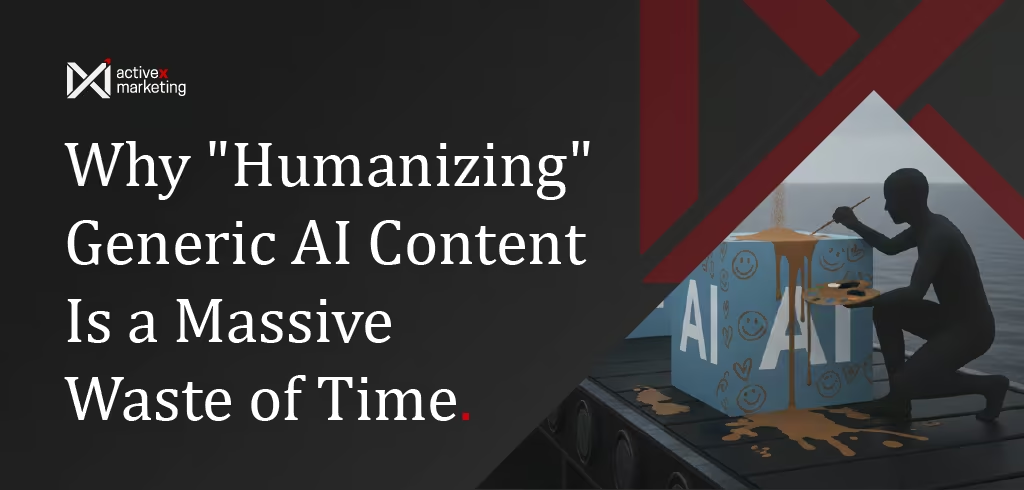
Why "Humanizing" Generic AI Content Is a Massive Waste of Time
The rush to use AI for content is blinding people to a crucial truth: speed without soul is worthless. Trying to "humanize" a bland, AI-generated draft is a time-suck that delivers zero real value. We're in the business of crafting expertise and connection, not polishing a robot's homework. The real power move is to use AI for structure and research, then write the insights yourself.
You know the feeling. You’ve got a mountain of content to produce, so you fire up the AI to get a “quick draft.” Fifteen seconds later, you’ve got 2,000 words. Great, right?
Wrong.
You read the output, and it’s a perfectly accurate, grammatically flawless, mind-numbingly generic blob of text. It’s got all the technical info, but it reads like a corporate memo from the year 2005. It uses all the right keywords but none of your swagger. No stories, no edge, no "Aha!" moments.
So, you roll up your sleeves and start the humanization process. You spend an hour rewriting awkward phrases, deleting endless adverbs, and trying to inject a personality that the machine killed in the first place. You end up spending 80% of the time you tried to save, and the final piece still feels... off. That right there is the digital dilemma, folks: the Humanizer Hustle, and it's a massive drag on your real potential.
The data is clear on what readers actually want. They can smell a fake a mile away, and a generic article will send your bounce rate through the roof.
Look at this: 90% of content marketers are using AI writing tools in 2025, according to a recent survey. That means if you're just using raw AI output, you're competing with a tidal wave of identical, beige content.
But here’s the kicker you need to internalize: Google and other search engines are prioritizing content that showcases E-E-A-T—Experience, Expertise, Authoritativeness, and Trustworthiness. The people who are winning aren't the ones generating 100 articles a week; they're the ones crafting one piece that is so packed with real experience that it stands out. Content that lacks a distinct point of view and original insight will not rank. Period. You can't edit in experience. You have to start with it.
The Anti-Humanizer Strategy
Trying to "humanize" bad AI output is like trying to turn a photocopy of a drawing into an original masterpiece by scribbling on it. It’s a fool’s errand. The smart way to use the machine isn’t for the final draft, but for the foundation.
Phase 1: Let the Robot Do the Heavy Lifting (But Keep It Muzzled)
This is where the AI is a game-changer. Use it for the things it’s great at, so you can save your brainpower for the things only you can do.
⚡️ Outline & Structure: Ask the AI for 10 different outlines on your topic. Pick the best one and use it as your scaffolding. Don't write a single word of the body yet.
🔎 Research & Data Gathering: Use it to find core facts, definitions, and, yes, those shocking statistics. But always, always, always fact-check the source.
💡 Brainstorming: Prompt it to generate counter-arguments or a list of pain points. It's a great sparring partner to find angles you missed.
Phase 2: Inject the Expert Factor (The Real Writing Begins)
Once you have the structure and the facts, the human takes over. This is where your actual expertise goes from a concept to digital gold.
The First-Person Opener: Ditch the robotic introduction. Start with a story only you could tell. A disaster you narrowly avoided, a lesson you learned the hard way, or an anecdote from a client call. This immediately establishes Experience and Trustworthiness.
The Strong, Opinionated Take: AI will never tell you that a sacred-cow marketing tactic is garbage. You can. Use strong, active voice and definitive statements that a machine wouldn't dare utter. This is your Authority.
Actionable, Proprietary Steps: The core of your Master Class should be your unique process. Break your solution into steps that your competitors haven't even thought of. Use bolding and lists to make your unique value impossible to miss.
Vary the Rhythm: Stop writing like every sentence has the same length and structure. Mix short, punchy sentences with longer, more complex ones. Humans do this naturally; AI is overly consistent. Read your work out loud. If it sounds like a lecture, it’s not done.
The Conclusion
If you’re spending your time polishing a dull, AI-generated draft to make it sound "a little more human," you’ve fundamentally misunderstood the assignment. Your goal isn't to mimic humanity; it’s to deliver undeniable, unique expertise.
The AI is your intern: fast, great at gathering data, but utterly useless for strategy and soul. Your job is the CEO: setting the vision, injecting the personality, and adding the insights that come from years in the trenches.
Stop trying to humanize the robot. Start writing like the expert you are. That’s the content that wins.
Frequently Asked Questions
Here are the answers to the questions we hear most often. If you don't find what you're looking for, feel free to contact us directly—we're happy to help.
What is "humanizing" AI content, technically?
It refers to the manual or automated process of editing raw AI-generated text to remove common "tells" (like repetitive sentence structure, generic phrasing, and a lack of emotional tone) to make it sound more like it was written by a person.
Why do people feel the need to humanize AI content?
Primarily to avoid being flagged by AI detection tools, to make the content more engaging for human readers, to inject a specific brand voice, and to enhance the content's perceived quality and expertise.
Does Google penalize raw AI-generated content?
Google has stated it doesn't penalize content just because it's AI-generated. However, it does penalize content that is unhelpful, low-quality, lacks E-E-A-T, and is purely created for search engine ranking, which is often the result of unedited, generic AI output.
What are the biggest "tells" that content is AI-generated?
Over-reliance on formal transition words ("Furthermore," "In conclusion," "It is important to note"), perfect but repetitive sentence length/structure, overuse of flowery or cliché metaphors ("a vibrant tapestry," "embark on a journey"), and a complete lack of personal anecdote or strong, biased opinion.
Is using an AI "humanizer tool" a good idea?
These tools can mask AI "tells" to bypass detectors, but they rarely inject true voice, unique insights, or lived experience. They solve a mechanical problem, not a value problem. Your human oversight is still required for the high-value content.
Can AI help me find my unique voice?
Yes, but only as a starting point. You can feed the AI examples of your best, most unique writing and ask it to analyze and apply that voice to a new draft. You still need to fine-tune and add the original thought.
How can I use AI to help with my storytelling?
Ask the AI to brainstorm analogies, metaphors, or a "Hero's Journey" structure for your core concept. For example, "Give me three relatable analogies for how a clogged marketing funnel works."
I still need to be fast. What's the best 5-minute editing hack for AI drafts?
The Aggressive Adverb/Adjective Purge. Search your draft for words like truly, genuinely, incredibly, pivotal, substantial. These are often AI filler. Delete them and see if the sentence is stronger without it. It usually is.
How do I ensure my E-E-A-T comes through?
Inject specific details that only an experienced pro would know. Mention a real-world client result (anonymized if needed), discuss a niche industry trend that hasn't hit the mainstream yet, or reference a proprietary framework you personally developed.
Should I worry about my sentences being too simple if I’m trying to avoid robotic phrasing?
No. Clarity is king. Mix your sentence lengths. Starting a paragraph with a short, punchy sentence like, "It's a mistake." is far more engaging and human than an overly structured opener.
What's the ratio of AI-to-Human effort I should aim for?
For a high-value blog post, aim for a 30% AI / 70% Human ratio. 30% for research, outline, and fact-checking. 70% for the unique angle, the personal stories, the deep insights, and the final voice.
Where should my brand's personality be most obvious?
In the Introduction (Hook), the Headings/Subheaders, and the Conclusion (Final Call to Action). These are the touchpoints readers remember most. Make them sound like you.



0 Comments