Social Media Marketing: The Ultimate Blueprint to Drive Brand Awareness and Sales
Modern customer acquisition relies on dynamic digital touchpoints, yet many brands treat social media marketing as a static broadcasting channel rather than an interactive conversion funnel. This passive approach wastes valuable ad spend and fails to capture the attention of modern consumers who demand authentic, high-value engagement before committing to a purchase. Relying on outdated, one-way broadcast methods results in skyrocketing customer acquisition costs, plummeting organic visibility, and a complete disconnection between top-of-funnel brand awareness and bottom-of-funnel sales. Without a systematic, data-driven framework to align metrics with core business objectives, organizations suffer from flatlining engagement rates while nimbler competitors aggressively capture their target market share. This comprehensive blueprint outlines a production-ready framework to reverse this trend and drive sustainable growth. We deliver an actionable roadmap to build a high-ROI strategy, execute a high-performing content pillar model, leverage paid acquisition networks to accelerate conversions, and evaluate whether to scale operational execution through in-house resources or specialized external services.
What is Social Media Marketing (SMM) in Modern Digital Marketing?
Social media marketing (SMM) is a strategic digital marketing practice that uses social networks to build brand awareness, drive traffic, and generate sales. By engaging target audiences with tailored content, brands convert passive users into interactive communities and long-term customer advocates.
The Evolution of Online Marketing: From Passive Broadcast to Interactive Communities
Traditional online marketing relied heavily on static websites and one-way email blasts to reach target audiences. Modern digital marketing demands bidirectional engagement, where target markets actively participate in brand narratives. A modern social media marketing strategy shifts the focus from static broadcasting to building self-sustaining digital communities. These interactive spaces foster trust, turning standard customer transactions into collaborative brand relationships.
Moving Beyond Brand Awareness: Driving Full-Funnel Conversions
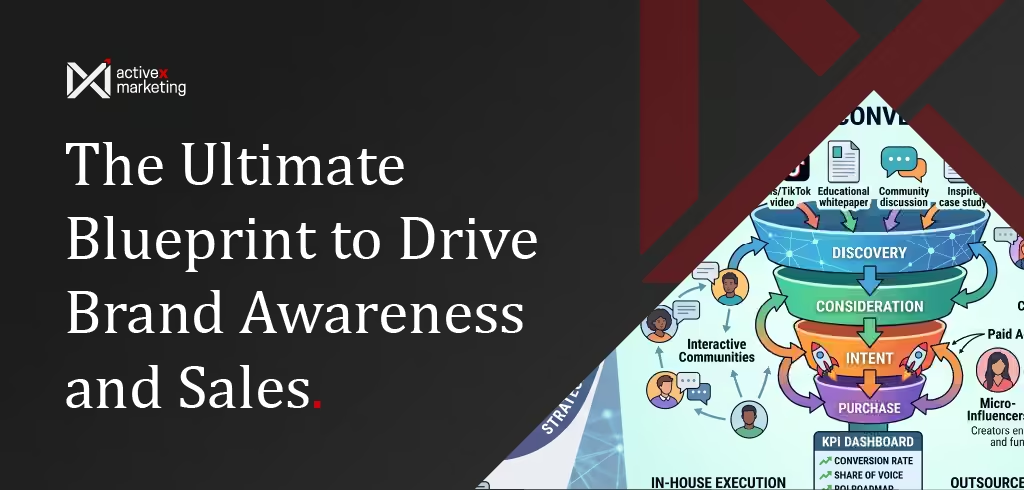
Broad visibility on social networks acts as the critical entry point for the modern acquisition funnel. However, modern campaign strategies must bridge the gap between initial brand awareness and bottom-of-funnel customer acquisition. Social touchpoints must be strategically engineered to guide prospects from discovery to purchase intent. Optimizing these interactions effectively lowers customer acquisition costs (CAC) while increasing customer lifetime value (LTV) through sustained community engagement.
Step-by-Step Guide: Building a High-ROI Social Media Marketing Strategy
Building a high-ROI social media strategy requires transitioning from speculative posting to execution grounded in data. Businesses must systematize their workflows to turn engagement metrics into predictable pipeline revenue. The following steps outline the exact methodology needed to build an authoritative, conversion-focused social presence.
Step 1: Aligning Social KPIs with Core Business Objectives
Every successful social campaign begins by anchoring platform actions to high-level organizational goals. Vanity metrics like likes must be replaced with indicators of business growth, such as conversion rates and share of voice. The SMART framework ensures that every social initiative is specific, measurable, achievable, relevant, and time-bound.
- Specific: Define target objectives, such as generating enterprise leads rather than general traffic.
- Measurable: Track quantitative metrics such as click-through rates (CTR) and marketing qualified leads (MQLs).
- Achievable: Establish realistic growth targets based on historical campaign baselines.
- Relevant: Align social tactics directly with quarterly business revenue requirements.
- Time-bound: Set strict deadlines, such as achieving a 15% increase in lead generation within 90 days.
Step 2: Customer Persona Mapping and Audience Research
Effective marketing requires a granular understanding of where target buyer personas consume information. Native analytics suites and social listening tools reveal demographic data, active hours, and content preferences. Scraping community forums and industry hubs helps identify specific audience pain points and recurring operational challenges. This raw quantitative data is then used to construct detailed customer personas that guide creative messaging.
Step 3: Conducting a Competitor Content Audit
Competitor analysis exposes critical content gaps and commercial positioning opportunities. Auditing rival brands involves cataloging their high-performing creative formats, posting frequencies, and active engagement tactics. This evaluation reveals what resonates within the market and highlights underserved customer demands. The gathered intelligence forms the foundation for differentiating the brand's own content delivery.
Content Creation: The Engine of Organic Engagement
Organic content functions as the digital storefront where brand value is established and demonstrated. Consistent, structured publishing builds topical authority and encourages natural community growth. To maintain audience attention, content must balance diverse messaging formats through a structured organizational system.
The Content Pillars Framework: Educate, Entertain, Inspire, and Convert
Relying on ad-hoc posting leads to inconsistent messaging and audience fatigue. A structured content pillar framework organizes publishing schedules around four core objectives: education, entertainment, inspiration, and conversion. Following the 80/20 rule, eighty percent of social assets provide non-promotional value, while twenty percent focus on direct sales.
- Educate: Provide step-by-step technical guides, industry whitepapers, and how-to videos explaining complex processes.
- Entertain: Use lighthearted workplace humor, memes, and cultural references that resonate with the target demographic.
- Inspire: Share customer success stories, case studies, and brand origin narratives that highlight shared values.
- Convert: Present product demonstrations, limited-time offers, and direct calls-to-action to capture sales.
Video-First Strategy: Capitalizing on Reels, TikTok, and YouTube Shorts
Modern social algorithms heavily favor short-form vertical video formats. Capitalizing on this trend requires producing dynamic visual content optimized for platforms like Reels, TikTok, and YouTube Shorts. Successful video execution relies on capturing viewer attention within the first three seconds with an explicit visual or verbal hook. Videos must utilize sound-on optimization, dynamic editing, and keyword-rich captions designed to rank in native platform search engines.
Paid Acquisition: Utilizing Social Media Advertising to Accelerate Sales
While organic content establishes authority, paid advertising operates as the accelerant for predictable business scaling. Strategic paid campaigns allow brands to bypass algorithmic bottlenecks and target high-intent buyers with pinpoint accuracy. Integrating targeted paid acquisition into the broader strategy ensures rapid pipeline velocity and consistent customer generation.
Scaling Lead Gen and E-commerce with Facebook Marketing Services
Organic reach alone is rarely sufficient to drive rapid, predictable revenue growth. Scalable lead generation and e-commerce campaigns rely on leveraging advanced Facebook marketing services to target specific customer segments. Utilizing Advantage+ shopping campaigns automates creative testing and budget allocation for optimal performance. High-performing funnels pair cold-audience targeting using custom lookalikes with precise retargeting campaigns to capture warm prospects.
Visual Commerce with an Instagram Advertising Agency Strategy
Instagram operates as a highly visual commerce platform where aesthetic quality directly impacts conversion rates. A professional Instagram advertising agency strategy prioritizes high-impact creative elements designed to interrupt user scrolling. Deploying multi-card Carousel Ads showcases product versatility and drives higher click-through rates (CTR). Integrating Instagram Shops directly into these ad assets streamlines the checkout process for high-intent audiences.
Influencer Marketing: Borrowing Authority to Scale Trust
Modern audiences increasingly tune out traditional brand advertisements in favor of peer recommendations. Influencer partnerships bridge this credibility gap by leveraging third-party endorsement to validate brand claims. Deploying a structured creator network allows brands to scale trust across targeted consumer segments.
Micro vs. Macro-Influencers: Aligning Budgets with Campaign Objectives
Partnering with established creators allows brands to instantly leverage built-in trust and authority. Choosing between micro-influencers and macro-influencers depends entirely on the overarching goals of the marketing campaign. While macro-influencers offer massive reach, micro-influencers often deliver significantly higher engagement rates at a fraction of the cost.
| Metric / Criteria | Micro-Influencers (<50k Followers) | Macro-Influencers (>100k Followers) |
|---|---|---|
| Primary Goal | Direct-response sales, niche trust | Broad brand awareness, massive reach |
| Engagement Rate | High (typically 3% - 8%) | Moderate (typically 1% - 3%) |
| Cost Efficiency | High (cost-effective CPM/CPE) | Low (premium flat rates per post) |
| Audience Alignment | Highly targeted, specialized niches | Broad, diverse demographics |
Managing Campaigns, Licensing, and Measuring Influencer ROI
Successful influencer campaigns require rigorous operational management and clear contractual guidelines. Organizations must formalize licensing agreements that outline content usage rights and whitelisting permissions for paid amplification. Attributing return on investment (ROI) relies on implementing tracking systems, such as custom affiliate links and unique promotional codes. Measuring performance metrics like cost-per-acquisition (CPA) ensures influencer partnerships remain financially viable.
Operational Execution: In-House Teams vs. Social Media Management Services
Executing a high-performing digital marketing strategy requires a robust operational foundation and specialized skillsets. Organizations must determine the most efficient delivery model to balance content volume with budget limits. Selecting the right team structure directly determines campaign speed, quality, and long-term viability.
When to Hire an Internal Team vs. Outsource
Building an efficient marketing engine requires deciding between internal hires and specialized outsourcing. In-house teams offer deep brand alignment but require substantial overhead for salaries, benefits, and training. Conversely, partnering with professional social media management services provides immediate access to specialized talent and advanced technical resources.
| Operational Model | Pros | Cons | Avg. Monthly Cost | Scalability Metric |
|---|---|---|---|---|
| In-House Team | Deep brand alignment, instant pivot capability, direct control | High overhead, recruiting lag, single-point-of-failure risks | $8,000 - $20,000+ | Low (limited by headcount hours) |
| Boutique Agency | High-quality creative, multi-channel expertise, scalable resources | Less day-to-day integration, higher monthly retainer fees | $3,500 - $10,000+ | High (on-demand resource scaling) |
| Social Media Management Services | Structured processes, predictive costs, access to enterprise tools | Standardized workflows, less hyper-customized creative | $1,500 - $5,000 | Very High (standardized growth tiers) |
Core Tech Stack: Enterprise Social Media Management Tools
Scaling a digital marketing campaign requires a robust, integrated software stack to streamline daily workflows. Enterprise scheduling platforms automate publication across multiple networks, ensuring consistent brand presence. Social listening tools track brand mentions and market trends in real-time, providing immediate customer insight. Finally, unified analytics dashboards synthesize data across channels to deliver actionable performance reports for stakeholder review.
Monetizing the Social Ecosystem: From Passive Engagement to Measurable Market Dominance
Treating social media as an isolated, static broadcasting channel creates a costly disconnect between top-of-funnel customer acquisition efforts and actual bottom-of-funnel pipeline revenue. Organizations that fail to implement a structured, multi-funnel framework routinely overspend on paid ads while surrendering their market share to agile competitors who treat every online interaction as a measurable touchpoint. Conversely, mastering modern social media marketing transforms digital communities into predictable, self-sustaining engines of sustainable business growth and long-term customer loyalty.
This high-ROI execution demands far more than basic creative intuition; it requires rigorous operational execution, sophisticated paid acquisition structures, and enterprise-grade performance optimization. To lead these high-impact marketing initiatives and secure organizational authority, professionals and enterprise teams must validate their strategic capabilities with industry-recognized credentials. Establish your competitive advantage, upskill your marketing department, and drive measurable ROI by mastering advanced campaign methodologies through iCertGlobal’s industry-leading professional certification training programs.
Frequently Asked Questions
Here are the answers to the questions we hear most often. If you don't find what you're looking for, feel free to contact us directly—we're happy to help.
What is a social media marketing strategy, and why does my business need one?
A social media marketing strategy is a structured blueprint outlining goals, target channels, content plans, and performance metrics used to build brand equity and convert followers into customers. Your business needs one to streamline content creation, maximize the ROI of social media advertising, and establish clear KPIs. This blueprint ensures all digital marketing efforts directly support lead generation and customer acquisition.
Where can I find a proven social media strategy template?
Proven social media strategy templates are available through leading digital marketing authorities. To ensure effectiveness, a comprehensive template must contain these six essential components: * Audience Personas * Competitive Benchmarks * Content Pillar Allocation * Channel-Specific Posting Schedules * Paid Ad Budget Allocation * Monthly KPI Reporting Frameworks Integrating these elements allows organizations to optimize their social media management services and execute high-performing campaigns.
What is the best way to access a social media marketing guide PDF for offline training?
Users can access a comprehensive social media marketing guide PDF by downloading official training resources from certified industry authorities like HubSpot or Meta Blueprint. Alternatively, users can save this webpage directly to PDF using their browser settings (Ctrl+P or Cmd+P) for an instant, actionable offline reference. This process provides teams with immediate access to strategic insights on influencer marketing and paid amplification.
Can you provide some real-world social media marketing examples of highly successful campaigns?
Real-world social media marketing examples of highly successful campaigns demonstrate how structured content creation drives engagement. Three distinct, high-performing campaign models include: * **User-Generated Content (UGC) campaigns**: GoPro’s daily photo challenges motivate users to share high-quality media, driving organic reach. * **Interactive Polls & Conversational campaigns**: Spotify Wrapped creates highly shareable, personalized data roundups that dominate social feeds annually. * **Purpose-Driven Viral Video campaigns**: Dove’s Real Beauty sketches leverage emotional storytelling to build deep community trust.
How do I know if I should hire an Instagram advertising agency or manage ads in-house?
Determining whether to hire an Instagram advertising agency or manage ads in-house depends on budget, resources, and scale: * **Choose In-House** if monthly ad spend is under $3,000 and the internal team has strong graphic design and copywriting resources. * **Choose an Instagram Advertising Agency** if monthly spend exceeds $5,000, or the business requires advanced creative testing and professional conversion rate optimization (CRO) expertise.



0 Comments