17 Critical Email Marketing Mistakes to Avoid & Strategies to Dominate Your Digital Campaigns
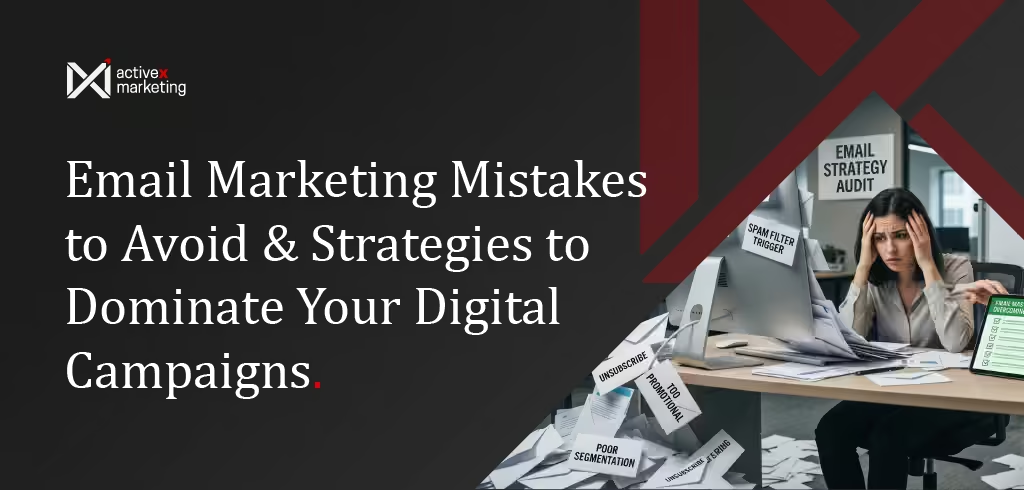
Despite its widespread adoption and perceived simplicity, true mastery of email marketing remains one of the most elusive yet powerful channels for digital growth. Many organizations, unfortunately, approach their campaigns with fundamental misconceptions, leading to outcomes far below their potential. The reality is that poorly executed email strategies don't just underperform; they actively erode sender reputation, inflate acquisition costs, diminish customer trust, and leave invaluable engagement and conversion opportunities untapped. These missteps aren't minor setbacks; they can fundamentally undermine a brand's entire digital presence and bottom line. This comprehensive guide meticulously dissects 17 critical errors prevalent in modern digital campaigns. We move beyond surface-level issues, addressing everything from foundational list acquisition blunders and segmentation deficiencies that alienate audiences, to sophisticated content strategy missteps and critical deliverability sabotage that sends messages straight to spam. Furthermore, we expose optimization oversights, automation underutilization, and analytical blind spots that prevent scalable success. Our objective is to not only expose these costly pitfalls but to unveil actionable, psychology-backed strategies to overcome them, ensuring your email efforts transform into robust drivers of customer engagement, loyalty, and sustained revenue growth.
1. List Acquisition Blunders: Building a Foundation of Irrelevance
Avoiding Purchased, Borrowed, or Publicly Available Email Lists
Purchasing, borrowing, or scraping email lists is a detrimental practice that damages sender reputation and leads to severe compliance issues. These low-quality lists result in abysmal engagement rates, high bounce rates, and potential blacklisting by internet service providers, ultimately undermining legitimate digital marketing efforts and customer engagement.
Such lists consist of recipients who never opted in, creating a fundamental breach of trust from the outset. This approach not only violates privacy regulations like GDPR and CAN-SPAM but also significantly increases the likelihood of being marked as spam. Businesses should instead prioritize organic list growth to foster genuine interest and high-quality interactions.
The Failure to Implement Effective Opt-In Strategies
Failing to provide clear, compelling opt-in opportunities across digital touchpoints means missing crucial opportunities for list growth. A robust opt-in strategy ensures that every subscriber explicitly consents to receive communications, forming the bedrock of an engaged and compliant email list.
Strategies for Growing a Compliant, Engaged Email List:
- Prominent Website Forms: Integrate subscription forms prominently on your website, blog, and relevant landing pages. These should be easily discoverable and clearly articulate the value proposition.
- Lead Magnets: Offer valuable content like e-books, whitepapers, webinars, or exclusive discounts in exchange for an email address. This incentivizes sign-ups and establishes perceived value.
- Checkout Opt-Ins: Provide an optional checkbox during the e-commerce checkout process, ensuring it's not pre-selected to maintain compliance. Clearly state what subscribers will receive.
- Social Media Integration: Utilize social media platforms to drive traffic to dedicated landing pages with compelling opt-in forms. Use targeted ads to reach potential subscribers.
- In-Person Events: Collect email addresses at trade shows or events with clear consent mechanisms, such as tablets for sign-ups or consent forms on physical registration sheets.
Neglecting Proof of Subscription and Consent
Maintaining verifiable proof of subscription and consent is absolutely essential for upholding email deliverability and ensuring legal compliance. Without clear records, organizations risk severe penalties for non-compliance and face heightened scrutiny from email service providers.
This documentation serves as evidence that each subscriber willingly opted into communications. It typically includes the date, time, IP address, and method of subscription. Robust record-keeping is critical for demonstrating adherence to data protection regulations and for resolving any potential spam complaints.
2. Segmentation & Personalization Deficiencies: The Generic Trap
The Costly Error of Sending the Same Email to Everyone
Sending identical emails to an entire subscriber base is a significant oversight that leads to low engagement, high unsubscribe rates, and missed conversion opportunities. Generic messaging fails to resonate with the diverse needs and interests of individual recipients, diminishing the perceived relevance of your email campaigns.
This one-size-fits-all approach neglects the unique stages of the customer journey, varying preferences, and distinct demographic profiles within an audience. Consequently, recipients are more likely to ignore, delete, or mark emails as spam, negatively impacting sender reputation and overall campaign performance within digital marketing.
Implementing Deep-Dive Subscriber Segmentation Strategies
Leveraging deep-dive subscriber segmentation strategies allows organizations to group audiences based on specific attributes, enabling highly targeted and relevant messaging. This approach significantly enhances the effectiveness of online marketing efforts by ensuring content aligns with recipient interests.
Key Segmentation Dimensions:
- Demographic Data: Age, gender, location, job title, industry, and company size. This helps tailor product recommendations or service offerings to specific audience groups.
- Behavioral Data: Website visits, past purchases, email open/click history, content downloads, and product views. Behavioral segments allow for timely, contextually relevant follow-ups.
- Purchase History: Products bought, order frequency, average order value, and date of last purchase. This informs cross-selling, upselling, and loyalty programs.
- Engagement Levels: Recent activity, email opens, clicks, or lack thereof. Segmenting by engagement helps identify highly interested subscribers versus those needing re-engagement.
- Customer Journey Stage: Leads, prospects, first-time buyers, loyal customers, or churn risks. Tailoring content to each stage drives appropriate actions and strengthens customer engagement.
Beyond First Names: Advanced Personalization for Enhanced Customer Engagement
Advanced personalization moves beyond basic first-name insertions, employing dynamic content and predictive analytics to craft highly relevant messages for individual recipients. This sophisticated approach significantly boosts customer engagement and conversion rates by demonstrating a deep understanding of subscriber needs.
It involves leveraging comprehensive data points to dynamically alter email content, product recommendations, or calls to action. By aligning messages with individual preferences, past interactions, and anticipated future needs, businesses can create a highly intimate and valuable communication experience. This level of tailoring transforms generic messages into highly compelling and personalized interactions.
3. Content Strategy & Messaging Missteps: Selling Too Hard
The Peril of Product-Heavy Messaging & "Selling Too Hard"
Overly promotional, product-heavy messaging bombards subscribers with sales pitches, leading to quick fatigue and high unsubscribe rates. This aggressive approach alienates audiences who seek value and information, not just constant solicitations, ultimately hindering long-term customer engagement.
This common mistake often prioritizes short-term sales over building lasting relationships, resulting in a transactional rather than a relational dynamic. Subscribers become desensitized to calls to action and perceive emails as irrelevant, severely impacting the effectiveness of future email campaigns.
Crafting Engaging, Value-Driven Email Campaigns
Crafting engaging, value-driven email campaigns requires a strategic balance between promotional content and providing genuine utility, education, or entertainment. This approach builds trust and rapport, fostering stronger customer engagement and increasing the overall effectiveness of your online marketing.
Strategies for Balancing Content Types:
| Content Type | Description | Impact on Engagement |
|---|---|---|
| Educational Content | How-to guides, industry insights, best practices, explainer articles, and expert tips related to your niche. | Positions your brand as an authority, builds trust, and provides tangible value. |
| Entertaining Content | Engaging stories, relevant anecdotes, fun facts, quizzes, or interactive elements. | Captures attention, fosters brand personality, and encourages sharing. |
| Helpful Content | FAQs, customer service tips, product tutorials, troubleshooting guides, or resource roundups. | Addresses pain points, improves user experience, and reinforces brand support. |
| Promotional Content | Product announcements, sales, discounts, limited-time offers, or event invitations. | Drives conversions directly but should be carefully integrated and not dominant. |
By consistently delivering value, subscribers anticipate and appreciate your emails, making them more receptive when you do introduce promotional offers. A content calendar can help ensure a strategic mix over time.
Lack of Clear Value Proposition or Call to Action
Every email must possess a singular, compelling value proposition that clearly explains "What's in it for me?" to the recipient, coupled with a distinct and actionable call to action. Ambiguity confuses subscribers and dilutes the message, significantly reducing the likelihood of desired outcomes for email campaigns.
Without a clear purpose, emails become noise in a crowded inbox. The value proposition should be evident in the subject line and throughout the email body, guiding the reader towards a specific next step. A well-defined call to action (CTA) removes guesswork, directing users to click, purchase, register, or learn more.
4. Deliverability & Sender Reputation Sabotage
Triggering Spam Filters Without Realizing It
Triggering spam filters occurs when email content, sender behavior, or technical configurations are flagged by email service providers (ESPs), preventing messages from reaching the inbox. This significantly reduces email campaign examples effectiveness and harms sender credibility.
Common triggers include excessive use of all caps, too many exclamation marks, certain spammy keywords (e.g., "free," "winner," "guarantee"), a poor image-to-text ratio, or broken HTML. Additionally, inconsistent sending volume and a high complaint rate can also signal spam-like behavior to automated systems.
Neglecting Your Sender Reputation & Email Deliverability
Neglecting sender reputation and email deliverability means ignoring the critical factors that determine if emails reach the inbox rather than spam folders. This oversight directly impacts the success of all effective email marketing strategies, causing messages to be lost and engagement to plummet.
Sender reputation is a score assigned by ESPs based on sending history, including bounce rates, spam complaints, and engagement metrics. Actively managing this score involves consistent list hygiene, authentic email content, and proper technical setup, ensuring maximum inbox placement and the efficacy of online marketing efforts.
Poor Email List Hygiene: The Unseen Drain on Performance
Poor email list hygiene, characterized by inactive or invalid subscribers, acts as an unseen drain on campaign performance, increasing bounce rates and damaging sender reputation. Regularly cleaning lists is a non-negotiable practice for maintaining high deliverability and improving overall customer engagement.
Inactive subscribers contribute to lower open and click-through rates, signaling to ESPs that your content is not valuable, which can lead to poorer inbox placement. Removing unengaged users and invalid addresses ensures that your metrics accurately reflect true engagement and that resources are focused on active, interested recipients.
5. Optimization & Automation Oversight: Missing Modern Demands
Failing to Optimize Emails for Mobile Devices
Failing to optimize emails for mobile devices is a critical oversight given that a majority of email opens occur on smartphones and tablets. Non-responsive designs lead to poor user experience, forcing recipients to pinch and zoom, ultimately reducing customer engagement and click-through rates.
A responsive email design adapts seamlessly to different screen sizes, ensuring readability and functionality across all devices. Neglecting this means subscribers are more likely to delete poorly formatted emails, directly impacting conversion goals and the perceived professionalism of email marketing campaign examples.
Sending Emails at the Wrong Time or With Inconsistent Frequency
Sending emails at suboptimal times or with an unpredictable frequency frustrates subscribers and diminishes campaign effectiveness. This oversight can lead to lower open rates, higher unsubscribes, and a general disconnect with your audience, harming overall customer engagement.
Analyzing audience behavior, such as peak activity times or geographic time zones, allows for strategic scheduling. Maintaining a predictable, yet not overwhelming, send frequency builds anticipation and ensures your emails remain a welcome presence in the inbox, contributing to the success of effective email marketing strategies.
Underutilizing Marketing Automation for Scalable Success
Underutilizing marketing automation means missing significant opportunities to deliver timely, personalized, and scalable customer experiences across the entire lifecycle. This failure limits the efficiency and effectiveness of digital marketing, preventing businesses from maximizing their return on investment.
Automation allows for the creation of sophisticated, multi-step email sequences triggered by specific user actions or predefined schedules. This includes welcome series, abandoned cart reminders, birthday greetings, and re-engagement campaigns, all designed to nurture leads, drive conversions, and enhance customer engagement without constant manual intervention.
Key Automated Email Campaign Examples:
- Welcome Series: A sequence of emails introducing new subscribers to your brand, products, or services. It establishes an initial relationship and guides them through key information.
- Abandoned Cart Reminders: Automated follow-ups to users who added items to their cart but did not complete the purchase. These often include incentives or helpful reminders.
- Re-engagement Campaigns: Designed to reactivate inactive subscribers by offering special content, discounts, or surveys to understand their changing preferences.
- Birthday/Anniversary Emails: Personalized greetings often paired with exclusive offers to celebrate milestones, fostering loyalty and positive brand sentiment.
- Post-Purchase Follow-ups: Emails providing order confirmations, shipping updates, product usage tips, or requests for reviews, enhancing the customer experience.
Optimizing Only for Web: Ignoring Email-Specific Design & Functionality
Optimizing email content solely for web browsers while neglecting email-specific design considerations leads to inconsistent rendering and degraded user experience. Email clients have unique rendering engines and limitations that require a tailored approach, impacting how email marketing campaign examples are displayed.
This means considering factors like dark mode compatibility, which can drastically alter color schemes, and the varying support for interactive elements across different email providers. Designing specifically for email clients ensures your messages look professional and function correctly, preserving brand integrity and recipient satisfaction.
6. Analytical Blind Spots: The Cost of Neglecting Data
Not Tracking Key Performance Indicators (KPIs) Beyond Open Rates
Failing to track comprehensive Key Performance Indicators (KPIs) beyond basic open rates provides an incomplete and misleading picture of campaign performance. This narrow view prevents informed decision-making and obscures the true effectiveness of effective email marketing strategies.
While open rates indicate initial interest, they do not measure actual engagement or conversion success. A holistic approach involves monitoring click-through rates, conversion rates, bounce rates, subscriber lifetime value, and return on investment (ROI) to truly understand and optimize online marketing efforts and customer engagement.
Failing to A/B Test Your Email Campaigns
Failing to consistently A/B test email campaigns means missing critical opportunities to systematically optimize various elements for improved performance. This oversight leaves significant gains in open rates, click-through rates, and conversions on the table, hindering the effectiveness of digital marketing.
A/B testing involves creating two versions of an email with a single variable changed (e.g., subject line, CTA button color, image) and sending them to a segment of your audience to determine which performs better. This data-driven approach allows for continuous refinement and maximizes the impact of email campaigns.
Ignoring Subscriber Feedback and Unsubscribe Reasons
Ignoring subscriber feedback and, particularly, unsubscribe reasons represents a lost opportunity to refine and enhance future email campaigns and marketing automation strategies. This neglect prevents valuable insights from being gathered, perpetuating inefficiencies and dissatisfaction.
When subscribers opt out, providing a short survey or a dropdown menu for their reasons (e.g., "too frequent," "irrelevant content," "not interested anymore") offers direct, actionable intelligence. Analyzing these trends helps identify systemic issues, allowing organizations to adjust content strategy, frequency, or segmentation to better serve the remaining audience.
Despite its widespread adoption and perceived simplicity, true mastery of email marketing remains one of the most elusive yet powerful channels for digital growth. Many organizations, unfortunately, approach their campaigns with fundamental misconceptions, leading to outcomes far below their potential. The reality is that poorly executed email strategies don't just underperform; they actively erode sender reputation, inflate acquisition costs, diminish customer trust, and leave invaluable engagement and conversion opportunities untapped. These missteps aren't minor setbacks; they can fundamentally undermine a brand's entire digital presence and bottom line. This comprehensive guide meticulously dissects 17 critical errors prevalent in modern digital campaigns. We move beyond surface-level issues, addressing everything from foundational list acquisition blunders and segmentation deficiencies that alienate audiences, to sophisticated content strategy missteps and critical deliverability sabotage that sends messages straight to spam. Furthermore, we expose optimization oversights, automation underutilization, and analytical blind spots that prevent scalable success. Our objective is to not only expose these costly pitfalls but to unveil actionable, psychology-backed strategies to overcome them, ensuring your email efforts transform into robust drivers of customer engagement, loyalty, and sustained revenue growth.
Frequently Asked Questions
Here are the answers to the questions we hear most often. If you don't find what you're looking for, feel free to contact us directly—we're happy to help.
How can I significantly improve my email open rates?
To significantly improve email open rates, focus on compelling subject lines, clear sender names, and optimized preheader text. Implementing deep-dive subscriber segmentation, as part of effective email marketing strategies, ensures your content is highly relevant. Regular list hygiene also contributes by targeting engaged recipients, boosting the likelihood of messages being opened.
What is email deliverability and why is it crucial for my campaigns?
Email deliverability refers to the success rate of emails reaching a subscriber's inbox rather than spam or junk folders. It is crucial for email campaigns because neglecting sender reputation directly impacts inbox placement, diminishing campaign visibility and effectiveness. Good deliverability ensures your messages reach their intended audience and drives engagement.
Is email marketing still an effective strategy in today's crowded digital landscape?
Yes, email marketing remains highly effective due to its impressive ROI and direct communication capabilities. It excels in delivering personalized content and nurturing customer relationships across the entire lifecycle, often integrating seamlessly with marketing automation for scalable success. Email continues to be a cornerstone for building robust customer engagement.
How often should I send emails to my subscribers without overwhelming them?
The optimal sending frequency for your email lists varies based on audience segmentation and content value. It is best determined through A/B testing and by monitoring engagement metrics like open and unsubscribe rates. Always prioritize providing valuable content with each send to maintain subscriber interest and avoid fatigue, rather than adhering to a rigid schedule.
What are the best email marketing platforms for small businesses looking to automate their campaigns?
Several platforms excel for small businesses seeking robust marketing automation and ease of use in their email campaigns: Mailchimp: User-friendly, good for beginners, with excellent templates. Constant Contact: Strong for event marketing and contact management. MailerLite: Affordable, with intuitive drag-and-drop builder. ActiveCampaign: Powerful for advanced automation and CRM integration. These platforms support growth and help implement best email marketing platforms for efficient operations.



0 Comments